
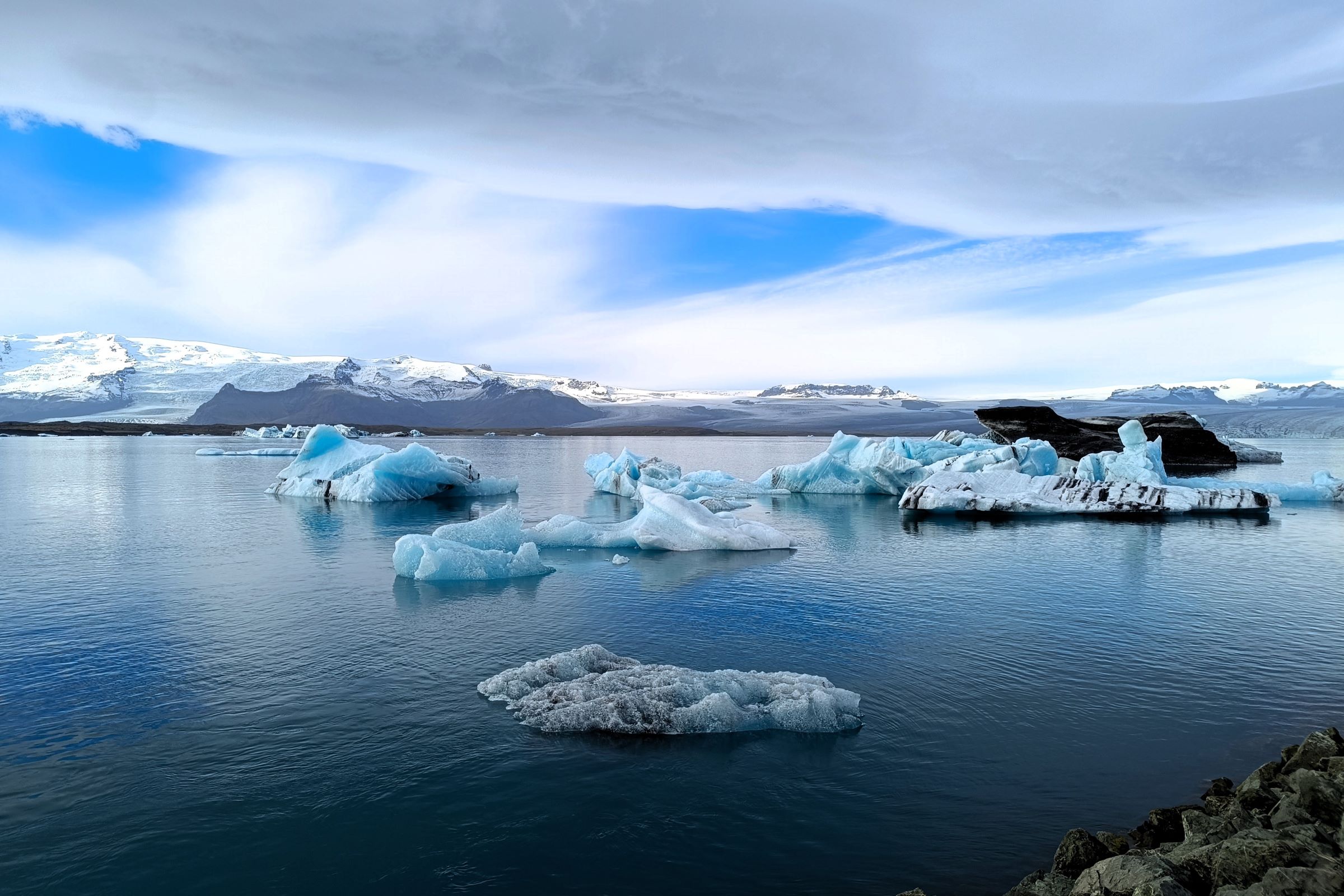
A fifteen-minute drive east of Fosshotel Glacier Lagoon, the Ring Road crosses a quiet valley of glacial rivers and moss-green moraines — and then, almost without warning, a second ice lagoon opens up on your left. This is Fjallsárlón, the smaller, calmer sister of Jökulsárlón. Most visitors roar straight past it on the way to the famous lagoon and Diamond Beach. Guests of ours who stop here tend to call it the best “extra” stop of their whole Ring Road trip: the same glacier-calving drama, a fraction of the crowds, and a viewing path short enough for nearly everyone.
30–60 minutes on site
Viewpoint free · small parking fee
All year · boats in summer
What Exactly Is Fjallsárlón?
Fjallsárlón is a terminal glacier lagoon at the snout of Fjallsjökull, an outlet tongue that slides down from the Öræfajökull volcano — the ice cap that also carries Hvannadalshnúkur, Iceland’s highest summit at 2,110 metres. Like its big neighbour Jökulsárlón, the lagoon formed as the glacier retreated and meltwater filled the basin it left behind. Icebergs calve off the glacier face, drift across the water, shrink, and eventually wash out toward the sea.
The difference is scale. Where Jökulsárlón is a sprawling, several-square-kilometre lake, Fjallsárlón is compact — you can see the whole lagoon, the ice face, and the surrounding mountains from one or two viewpoints. The glacier face comes closer to the shore here, which is why photographers love it: you get tight landscape compositions that are simply not possible at the larger lagoon.
Fjallsárlón sits inside the Национальный парк Ватнайёкюдль region, at the edge of the Öræfajökull volcanic system. Stay on marked paths — the moss and the soft volcanic soils recover slowly from foot traffic.
Getting There from Fosshotel Glacier Lagoon
Leave the hotel and turn east onto the Ring Road (Route 1). It is roughly 13 kilometres, about ten minutes of driving. The turn-off is clearly signposted “Fjallsárlón” on the southern side of the road, with a short access track leading to a small parking area. From the car park, a level gravel path of about 400–700 metres brings you to the lagoon shore viewpoint — allow 10–15 minutes each way, and wear shoes you don’t mind getting a little dusty.
If you are driving from Jökulsárlón instead, head west for roughly 15 kilometres; the turn-off appears a few minutes after you pass the Hofsnes/Ingólfshöfði area and cross the river plain.
What You’ll See — and Why It’s Different from Jökulsárlón
At Jökulsárlón, icebergs drift across a huge lake and make their way to the sea, where they wash up on Diamond Beach. At Fjallsárlón, the show is more concentrated: the glacier face is closer to the viewpoint, and the lagoon acts like an amphitheatre around it. On warm days you may hear — and see — calving, as chunks the size of cars split off the ice front. Because the lagoon is shallower and smaller, icebergs here tend to pile and tilt dramatically rather than glide.
In summer, a compact local operator runs small zodiac-style boat cruises on the lagoon, bringing you near the ice face with far fewer people on the water than at Jökulsárlón. Schedules and prices change each season, so check on site or book ahead with the operator if a cruise is a must-do for you. If boats are the priority, our comparison of Jökulsárlón boat tours — zodiac vs amphibian covers the big-lagoon options in detail.
Never climb onto grounded icebergs at the shore or enter the water. Ice bergs roll without warning, and the lagoon water is barely above freezing year-round. Keep children within arm’s reach — the shoreline drops off quickly in places.
Best Time to Visit Fjallsárlón
Summer (June–August): the full experience — boats running, midnight-golden light late into the evening, and the surrounding green slopes at their brightest. Crowds are modest but midday tour-bus waves do occur; come before 10:00 or after 17:00 for the quietest water.
Winter (November–March): the lagoon often partially freezes, and snow softens the whole valley. The glacier face views remain excellent, daylight is short (four to five hours around the solstice), and the quiet is profound. Check дорога.ис in winter — the access track is usually ploughed, but wind and drifting snow can slow everything in the corridor.
For a deeper seasonal comparison of the whole area, see our guide to Jökulsárlón in winter vs summer — nearly all of it applies to Fjallsárlón too.
Pairing Fjallsárlón With a Perfect Day
Because it sits so close to the hotel, Fjallsárlón slots easily into almost any itinerary from Fosshotel Glacier Lagoon:
Часто задаваемые вопросы
Is Fjallsárlón worth visiting if I’m already going to Jökulsárlón?
How long is the walk from the car park?
Are there boat tours at Fjallsárlón?
Can you see the glacier up close without a boat?
Planning your trip to Jökulsárlón?
Fosshotel Glacier Lagoon sits halfway between Skaftafell and Jökulsárlón — about 25 minutes of driving to either. The perfect base for everything described in this guide. Check live rates for your dates.

 English
 German
 Spanish
 Italian
 French
 Portuguese
 Turkish
 Swedish
 Russian
 Chinese
 Korean