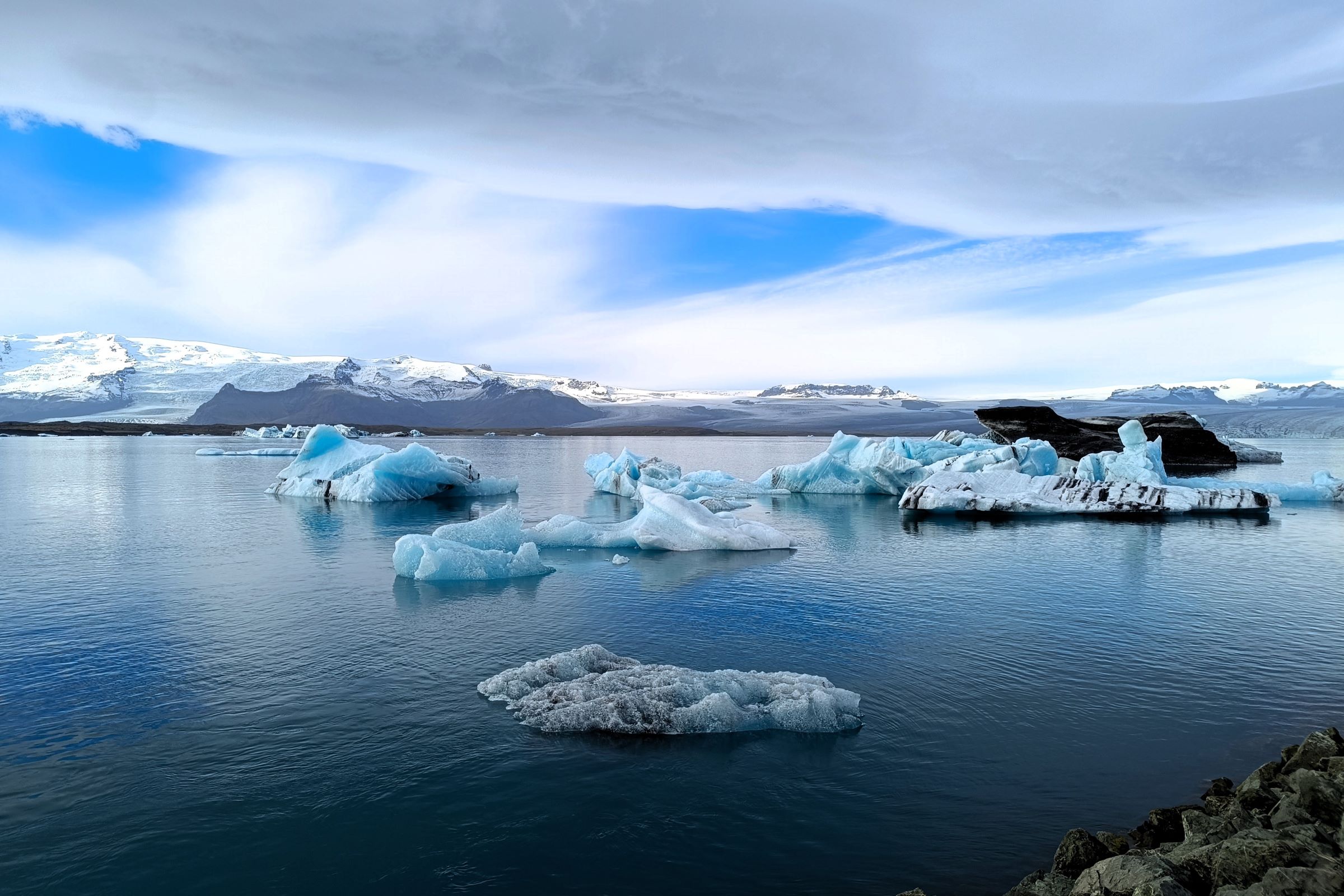
Most visitors come to Jökulsárlón for the ice. Stay a little longer — or simply drive the Ring Road with your eyes up — and you realise the lagoon corridor is one of Iceland’s richest wildlife windows: seals that haul out on drifting icebergs, arctic terns that nest on the sandurs and defend their eggs by dive-bombing, wild reindeer that descend to the coast in winter, and puffin colonies within an easy summer detour. Here’s what lives here, where to look, and how to watch without disturbing it.
Puffins: mid-May–early August
Reindeer: autumn–winter lowlands
Tern season: hats on, Jun–Jul
Seals: The Lagoon’s Year-Round Residents
Two seal species live around the lagoon and its outlet river: the harbour (common) seal and the grey seal. They hunt fish in the channel where the lagoon meets the sea, and — famously — haul out to rest on drifting and grounded icebergs. Summer and autumn are the easiest viewing seasons, when bergs act as floating sun decks. Watch from the shore by the main car park, from the Ring Road bridge, or best of all from a boat: the amphibian and zodiac tours regularly drift close to resting seals without disturbing them.
Give hauled-out seals space of at least 50–100 metres and never try to approach or feed them. If a seal raises its head and watches you, you are already too close — back off and it will settle again.
Arctic Terns: The Fearless Summer Neighbours
From late May to July, arctic terns nest on the gravel sandurs and spits around the lagoon. They are magnificent animals — migrating pole to pole each year, more than any other creature on Earth — and utterly fearless parents: walk near a nest and a tern will dive at your head, silent until the last second. The pecked hat is a rite of passage, but there’s a real point: keep to marked paths, don’t linger near colonies, and put a hat on small children in June and July. Their eggs and chicks are superbly camouflaged; straying off-path can literally crush them.
The same rules protect all the seabirds here — fulmars, skuas, gulls and eiders nest on the sandur and cliffs through summer. A telephoto lens gets you a better picture than any amount of creeping, and the birds get to raise their chicks.
Wild Reindeer: Winter Visitors from the East
Iceland has no native land mammals worth the name — which is why the wild reindeer here are special: they descend from animals introduced in the late 18th century, and today they live only in eastern and southeastern Iceland. Through spring and summer they graze the highlands; in late autumn and winter they move down toward the coast, and the flats and valleys between Hof, Jökulsárlón and Höfn are among the best places in the country to see them from the road.
Scan the moss plains at dawn, especially on frosty mornings between October and March — herds of a dozen or more graze in plain sight, sometimes close enough to photograph from a layby. Never leave the road to approach: they spook easily, and roadside parking rules exist for everyone’s safety.
Puffins: The Summer Special, 45 Minutes East
There are no puffin colonies at the lagoon itself, but Ingólfshöfði — a golden grass cape jutting into the sea east of Hof — hosts one of the region’s most charming colonies. From mid-May to early August, local farmers run hay-cart tours across the sands from Hofsnes farm: published 2026 pricing is around 12,500 ISK for adults and 6,250 ISK for children aged 6–16, with a minimum age of six on open departures. The cape’s cliff edge rings with puffins flying in with sand eels; binoculars recommended, windproof layers essential. Check the operator’s schedule — departures depend on tide and weather.
For the ultimate puffin experience in Iceland, serious birders continue east to Borgarfjörður eystri — but that is a full day’s excursion; Ingólfshöfði pairs beautifully with a Höfn lunch.
The Supporting Cast
Every animal here earns its living in a thin, cold ecosystem. Keep to paths, keep dogs leashed (and note that pets aren’t permitted in sensitive park zones), never feed wildlife, and let binoculars do the close-up work. The reward: seals that keep sleeping, terns that keep nesting, and reindeer that keep grazing where the next traveller can enjoy them too.
常见问题
Can you see seals at Jökulsárlón without a boat?
When and where can I see puffins near the lagoon?
Why do arctic terns attack people?
Where is the best place to see wild reindeer?
Planning your trip to Jökulsárlón?
Fosshotel Glacier Lagoon sits halfway between Skaftafell and Jökulsárlón — about 25 minutes of driving to either. The perfect base for everything described in this guide. Check live rates for your dates.


 English
 German
 Spanish
 Italian
 French
 Portuguese
 Turkish
 Swedish
 Russian
 Chinese
 Korean